 My presentation was titled "Here comes the 21st Century...are we ready?" and I started by discussing what exactly we mean by 21st Century and why it is really only quite recently that we've started talking about "21st Century Skills" and "21st Century Education" when the 21st century is already upon us.
  frustrated with their teachers - all because they don't understand that both groups are simply different. Last year I stumbled upon Michael McQueen's book, "New Rules of Engagement" and it resonated with me when it spoke about the paradigm rifts that exist between each generation. The rifts McQueen identifies in his book are:
- Concept of Truth
- Respect
- Patience
- Communication
- The Future
- Loyalty
- Work Ethic
- Learning
I honestly believe that if we understand these rifts, these points of conflict, we have a far better chance of connecting with our Gen Y learners and therefore facilitating their learning - in fact I've been priveldged enough to see a teacher very close to me make the shift after reading the book himself. McQueen's book was such a vital find for me in terms of me finding a way of explaining what it is that I see going wrong between so many Gen Y learners and the older generations, I highly recommmend it to anyone working or living with Gen Y.
It was about then I put the challenge out on the table - are we teaching the students in front of us, or the students we were? And shared a story about how the generational divide affects me as someone born towards the end of Gen X and beginning of Gen Y:
My father doesn’t own a computer, he’s never had an email account (let alone done an internet search) – he has no way of understanding my husband and I when we talk about wikis, blogs, RSS, ipod Touch, Twitter, Skype. Guess what that means? We don’t talk much about my work – and let’s face it my work is a big part of my life. There’s a generational divide there making the connection a lot harder – and we’re seeing that in schools between teachers and students too.
Technology isn’t going away, if anything our society is becoming more and more technology saturated. Educators have been doing the same old thing for a long time. When I was in my first year out of university I lost count of how many times I was told, “Why reinvent the wheel?” when I suggested new ways of doing things. The thing is, the essence of the wheel (a round object used to move things) may stay the same but over the years wheels have changed a lot – new materials and new technologies have found ways of making the wheel better at it’s job. For me, that’s what teachers finding ways to effectively integrate technology into their pedagogy is about.
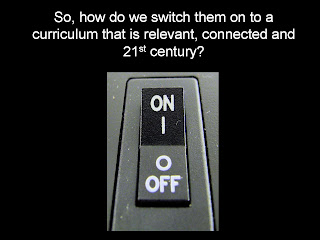
Picture: ‘1/0’ by sbfisher, from Flickr,
made available under a Creative Commons License
It was then that I flipped my own switch and showed them some of the tools I use in my classrooms and spoke about how easy it can be to use ICTs in meaningful ways to enrich their students in a 21st Century learning environment. Audacity, Twitter, Voki, Voicethread, Wikis, Blogs, Google (as more than a search engine), Ning, Piclits, BigHugeLabs all made it to my short list - although as we'd had to submit our presentations a couple of months ago it was slightly out of date. Go2Web20 also got a special mention as one way of finding great little Web2.0 applications.
As I wrapped up my 60 minutes I made sure to make the point that using ICTs in a 21st Century learning environment isn't about the technology, it's got to be about pedagogy first and foremost and talked about Andrew Churches' revised Bloom's Digital Taxonomy found at Educational Origami as one way we can look at the pedagogy behind our ICT use.
I tend to think in questions (which my students find frustrating at times, especially when instead of giving them the answer I ask them questions to guide them towards it themselves) and so I asked a lot of questions throughout my presentation, and I chose to leave them with the question which has stayed with me and pushed me to constantly review and adapt what I do in my classrooms:


made available under a Creative Commons License


