Showing posts with label presentation. Show all posts

Monday, March 23, 2009

Creating a New Stage: The Technology Makeover for Drama

Picture: "Tethers of this Scene", by wetsun@Flickr

A couple of weekends ago now I presented at the Drama Queensland annual conference about the work I did last year integrating technology into my drama classrooms. The above is one of my favourite slides from the whole experience. I often find people surprised when I admit that not all my projects and (brilliant) schemes work when I present them to my students - failure isn't something embrace in educational circles in my experience. But the reality is that it's my ability to acknowledge a project's failure that gives me the ability to "tweak" it and find out what will work.

I miss my drama classes a great deal as I work in my current role. Besides the fun and sheer randomness that tends to find its way into a drama classroom, I miss the challenge of integrating ICTs in a subject traditionally anti-tech. I miss pushing at the edges of a subject that is often on the fringes of the curriculum anyway (or which is missing completely from the National Curriculum at this stage).


There's a lot of untapped potential when it comes to the drama classroom and my decent into true nerdom in my teaching has been closely tied to my drama projects. This is the quick summary of my journey with a drama focus I shared at the conference:

2007 - “Searching for Mary” (Year 10)– students interacted online to develop roles and relationships, developing narrative through real time role plays. This was my first attempt at tapping into the idea of "cyberdrama". It was pretty...meh looking back on it. The students simulated emails and text messages using discussion boards and blogs. At that point in the journey for me it was about exploring how we could use those sorts of activities to enhance character and narratives we were building in the physical space of the drama room. While I wasn't impressed with the project's ICT stuff, the use of it to explore unconventional dramatic structures worked quite well and the students performance pieces were fairly impressive.

2008 - Collaborative “Juice” (Year 10)– students from two different schools studied the same play and worked online to build character profiles. This project emerged out of a PLN moment. I was at last year's drama conference chatting with a colleague I'd connected with a couple of years ago through some workshops and we realised we'd be studying the same play the following term. We'd been trying to organise a joint project for a year or so and this gave us the perfect opportunity. This one was fun - it pushed the student's to a new level and it was interesting to see two very different groups connect the dots and realise they weren't the only drama class in the state.

2008 - A Guided Tour of European Theatre (years 7&8) – students interacted online in role and oocly as they studied and experienced different European theatre forms. We offer an elective style program for our middle school students and while the units align with the curriculum documents and the like there's room for us to have fun - and this one (while an incredibly draining way to end the year) was loads of fun. We all created characters who were on tour through time and Europe while they studied significant western theatre styles. The big focus for this one was getting students some basic drama knowledge and to have them engage in reflection - something I've always struggled to get drama students to do effectively. I found that by letting students build a Tour Group Network through in character blogs and wikis they did much better at this then I'd previously encountered.

...jeeze...2008 was a massive year for me....

2008 - Create your own…my most ambitious project to date. I gave students a space in the EQ learning environment where they were able to simulate their own cyberdrama. They explored how social media can be used to create an interactive and disjointed narrative where all the little pieces added up to one story. This one came out of one of those "failures". After 9 weeks of hitting my head on a brickwall and the rebellion mounting I admitted defeat and took it to the circle, "What would make it work?" This project was the students' idea and was AWESOME. A massive job, tiring and life consuming - but it was so worth it. Every lesson was a learning curve for us all and the students showed even the Learning Place Mentor a thing or two about the possibilities in LP Project Rooms. Remember how I said I'd always had trouble getting students to reflect before? For this project they needed to keep a creation journal tracking HOW and WHY they did what they did to build their drama. The task requirements were 500-700 words over the 7 week period. They spent HOURS collating the most amazing and astounding journals I'd ever seen in drama...and the shortest one must have been 1000 words...(the flip side, I had to mark them all..it was so hard to stay focused!)


It was a very different presentation from the QSA one I wrote about over the weekend - there was a lot more resistance from Drama QLD delegates.

Resistance may not be the right word...negativity perhaps? A lot of "Oh you can do that in your school, we wouldn't be able to." A lot of excuses got thrown around and I find that sad - one of my personal mottos is that if there is a will there must be a way. But I can't change where they're at in their digital journeys - I can only show them the possibilities and hope that one day I won't be the only one looking for ways to utilise blogs, wikis, etherpad, chatrooms, vlogs, annotation options on YouTube, Vokis, BigHugeLabs, etc in my drama classroom.

Saturday, March 21, 2009

21st Century...Are We Ready?

Last Friday, I was lucky enough to have been given the opportunity to present at the Queensland Studies Authority's Senior Schooling conference. When they first approached me I had just won my award and was totally awed that they'd want me to speak - after all there's all sorts of "big" educational names presenting at these things!

Despite my reservations, I agreed and decided that I'd use the opportunity to talk about what I believe about 21st education and the need for our schools and teachers to 'shift' in order to provide the best possible education for our students. I knew not everyone would like what I had to say, so when one or two people decided it wasn't the session for them and walked out I wasn't too worried - afterall, there's no point attempting to convert the ones who refuse to hear the message. At the end of the session I was pleased have people from all sorts of backgrounds - policy developers, university lectures, teachers and school leaders stay back to talk briefly about my message. Generally, their feedback was that I'd given them a great deal to think about. Bonus for me!

It may be cheating slightly as a blog post, but I would like to share what I spoke about with those who read my blog. You are the ones I have found inspiring, challenging and truly enriching as I have made connections through a vibrant online personal learning network and I would love your feedback - the good, the bad and the ugly about what I shared. Did I miss the point? Did I leave something vital out?
My presentation was titled "Here comes the 21st Century...are we ready?" and I started by discussing what exactly we mean by 21st Century and why it is really only quite recently that we've started talking about "21st Century Skills" and "21st Century Education" when the 21st century is already upon us.

I started by talking about the fact that when the Industrial Revolution sparked global reform of things such as family life, work and education it was a slow change in many places because of certain change barriers - communication, speed of travel and concentration of 'experts' and tied that with the fact that in the last 100 years (or less) we've been experiencing a Communication and Information Revolution which has snowballed across the globe far quicker than anything like it before, and that this has had a transformational impact on our society which has led to some fundamental changes in our world.

One of the biggest changes we need to deal with in our schools is the learners in our classrooms. I see so many teachers frustrated with the teenagers in their rooms and so many teenagers frustrated with their teachers - all because they don't understand that both groups are simply different. Last year I stumbled upon Michael McQueen's book, "New Rules of Engagement" and it resonated with me when it spoke about the paradigm rifts that exist between each generation. The rifts McQueen identifies in his book are:
  1. Concept of Truth
  2. Respect
  3. Patience
  4. Communication
  5. The Future
  6. Loyalty
  7. Work Ethic
  8. Learning

I honestly believe that if we understand these rifts, these points of conflict, we have a far better chance of connecting with our Gen Y learners and therefore facilitating their learning - in fact I've been priveldged enough to see a teacher very close to me make the shift after reading the book himself. McQueen's book was such a vital find for me in terms of me finding a way of explaining what it is that I see going wrong between so many Gen Y learners and the older generations, I highly recommmend it to anyone working or living with Gen Y.

It was about then I put the challenge out on the table - are we teaching the students in front of us, or the students we were? And shared a story about how the generational divide affects me as someone born towards the end of Gen X and beginning of Gen Y:

My father doesn’t own a computer, he’s never had an email account (let alone done an internet search) – he has no way of understanding my husband and I when we talk about wikis, blogs, RSS, ipod Touch, Twitter, Skype. Guess what that means? We don’t talk much about my work – and let’s face it my work is a big part of my life. There’s a generational divide there making the connection a lot harder – and we’re seeing that in schools between teachers and students too.

Technology isn’t going away, if anything our society is becoming more and more technology saturated. Educators have been doing the same old thing for a long time. When I was in my first year out of university I lost count of how many times I was told, “Why reinvent the wheel?” when I suggested new ways of doing things. The thing is, the essence of the wheel (a round object used to move things) may stay the same but over the years wheels have changed a lot – new materials and new technologies have found ways of making the wheel better at it’s job. For me, that’s what teachers finding ways to effectively integrate technology into their pedagogy is about.

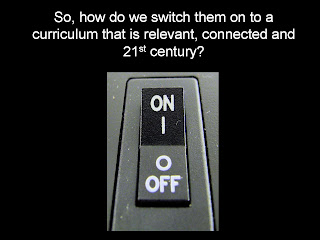
At that point I asked the hardest question for those new to the 21st Century bandwagon:

Picture: ‘1/0’ by sbfisher, from Flickr,
made available under a Creative Commons License


It was then that I flipped my own switch and showed them some of the tools I use in my classrooms and spoke about how easy it can be to use ICTs in meaningful ways to enrich their students in a 21st Century learning environment. Audacity, Twitter, Voki, Voicethread, Wikis, Blogs, Google (as more than a search engine), Ning, Piclits, BigHugeLabs all made it to my short list - although as we'd had to submit our presentations a couple of months ago it was slightly out of date. Go2Web20 also got a special mention as one way of finding great little Web2.0 applications.

As I wrapped up my 60 minutes I made sure to make the point that using ICTs in a 21st Century learning environment isn't about the technology, it's got to be about pedagogy first and foremost and talked about Andrew Churches' revised Bloom's Digital Taxonomy found at Educational Origami as one way we can look at the pedagogy behind our ICT use.

I tend to think in questions (which my students find frustrating at times, especially when instead of giving them the answer I ask them questions to guide them towards it themselves) and so I asked a lot of questions throughout my presentation, and I chose to leave them with the question which has stayed with me and pushed me to constantly review and adapt what I do in my classrooms:


Picture: ‘No More Miracles’ by birdbath, from Flickr,
made available under a Creative Commons License
I left the room feeling positive and my colleague who came to watch was buzzing about it the whole way home - it was wonderful for me to hear him start to make the connections between what he and his staff are currently doing and what the next step for them in terms of 21st Century education needs to be. Now, it's back to the grindstone and getting my hands dirty helping those around me make that step - I love being able to share what it is I'm passionate about.